
Start with one customer you already serve. The owner wants proposals to move faster. The operations lead wants reliable answers from company documents. The IT team wants a workflow that can take action across systems. Each is an AI opportunity, and each calls for a different kind of help.
Omdia’s Lisa Lawson puts the potential North American AI-services market at approximately $149 billion by 2031, as reported by Kelly Teal in Channel Dive on October 5, 2026. That forecast provides the context. Your next sale starts with a defined problem, a workable test and a delivery team that can support the result.
For an owner-led advisory business, the practical role is to lead discovery, help the customer compare options and bring in the right specialists. You can develop the opportunity while an MSP or implementation partner handles the engineering, deployment and ongoing operations.
Choose a starting point for the customer’s work
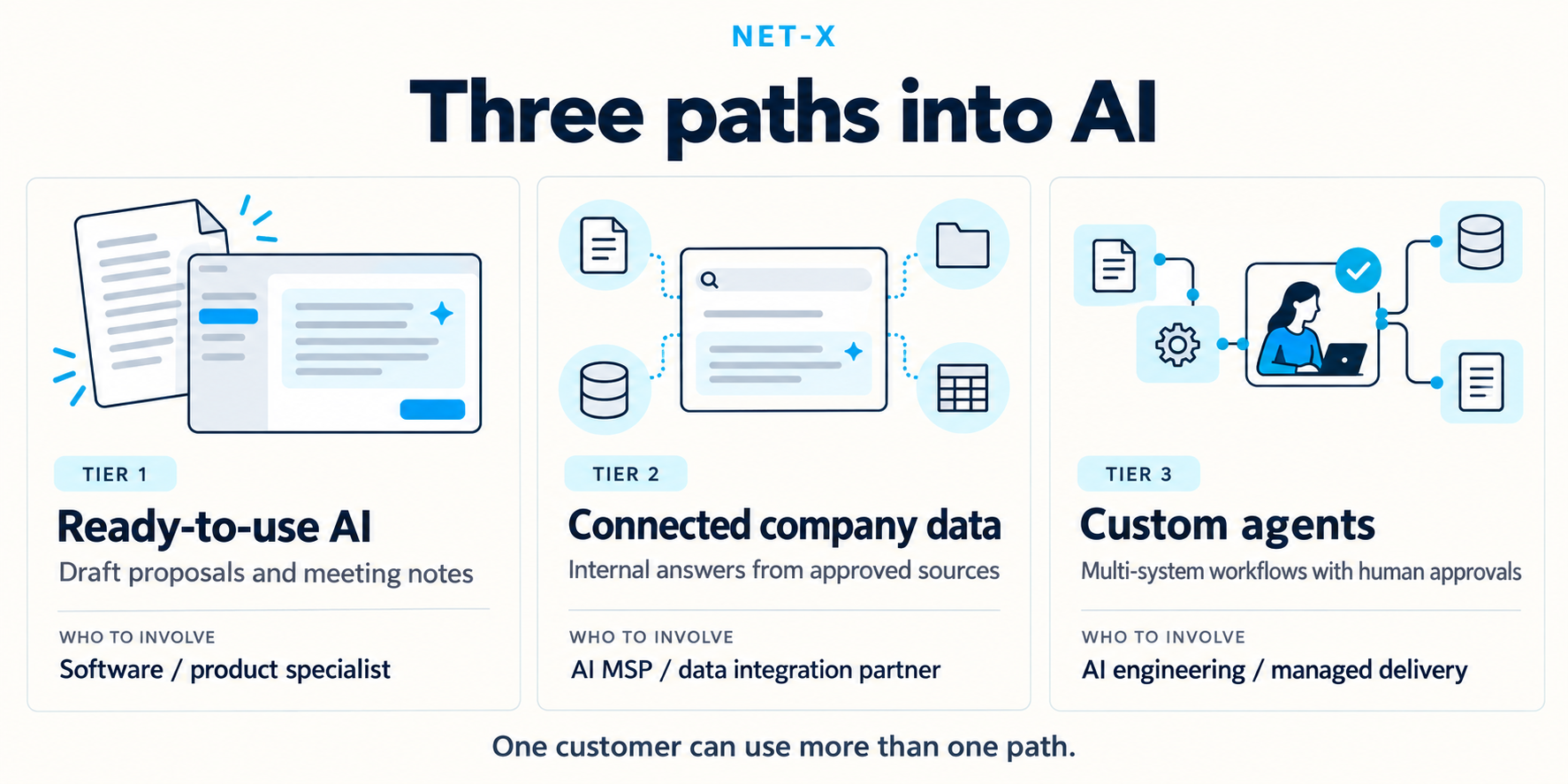
Tier 1 — Ready-to-use AI
Start here when the customer wants help with an everyday task inside software they can adopt now: drafting, meeting notes, call handling or employee assistance. AI features in Microsoft 365 Copilot, Zoom Workplace and Dialpad are useful places to investigate. Confirm the current product, plan and feature entitlement; familiar platform names cover different offers.
Ask the owner: “Which repeated task still waits for you, even though someone else has already done most of the work?” A proposal draft or customer follow-up is concrete enough to demonstrate. Inventory the software the customer already pays for before adding another subscription.
For the first test, use sample material and compare the time to an approved result, including the corrections. A faster draft that creates extra review work may not help. Ask who will use the tool, who approves its output and how adoption will be supported.
Your role is to connect the business need to a suitable product and rollout. Bring in the product specialist for licensing, configuration and training. If company content will be connected, involve the data owner too: Microsoft’s Copilot guidance makes clear that existing access permissions matter.
Tier 2 — Connected company data
Start here when employees need useful answers from internal documents, CRM records, policies or other approved company information. The work includes preparing sources, checking permissions, connecting systems and testing whether answers are reliable.
A common approach is retrieval-augmented generation, or RAG: the system retrieves relevant material and supplies it as context for the model. Amazon Bedrock’s documentation describes this pattern and the use of source citations. It still needs testing for accuracy, missing information and inappropriate access.
Ask the operations lead: “Which questions do people keep asking because the answer is spread across different systems?” Choose one bounded knowledge set, a named owner and a handful of real questions. Include a question the system should decline to answer and a document a test user should not be able to see.
This is where an experienced MSP or data implementation team becomes useful. CBTS’s data-engineering services include vector storage for RAG and embeddings, while CBTS Forge Agents offers agent build, governance and operations services in customer tenancy or private infrastructure. Ask its team to scope the data, integration and security work. CBTS also publishes an internal Claude Enterprise case study; its own use of Claude does not establish Anthropic resale authorization.
CBTS’s public channel page names AppDirect, AVANT, Bridgepointe, Intelisys, Sandler Partners and Telarus, among others. That gives an advisor specific relationships to investigate. The exact service, country, contracting entity and advisor eligibility still need confirmation.
Tier 3 — Custom agents
Start here when the customer needs a system to carry out a defined workflow across tools, with appropriate permissions and human checkpoints. An example might be gathering order information, drafting a response and routing an exception to an employee before an update is made.
Ask the process owner: “Which repeatable workflow has clear rules, costly handoffs and an outcome we can measure?” Map the steps and exceptions before choosing a model. Start with limited access and decide which actions require approval, how activity is logged and how someone can stop or reverse a mistake.
Netrix Global’s agent buildouts and integration services describe permission controls, human checkpoints and ongoing AI operations. Telarus publicly lists Netrix Global with AI capabilities. CBTS Forge Agents is another delivery option to investigate. These are concrete starting points for a scoped specialist conversation, subject to the customer’s environment and the actual commercial route.
Ask the delivery partner to compare a platform’s existing agent capabilities with a custom build. Establish the pilot cost, success criteria, support model and ongoing usage budget. A custom-agent project does not automatically require dedicated GPUs, model training or a large infrastructure change.
Check the supporting services the project actually needs
A useful AI solution may also need data work, security, cloud infrastructure or cost management. Scope each against the proposed workload. There is no universal infrastructure-spend multiplier for a dollar of AI usage.
- Infrastructure and connectivity. Ask where the data and application will run, how much data moves, and what latency, resilience or capacity the workflow needs. A specialist can then assess cloud connections, colocation, private infrastructure or GPU requirements. An existing network may already be sufficient. Examples to assess include Equinix private AI, Digital Realty AI infrastructure, Flexential GPU-ready colocation and Megaport compute. These offers solve different parts of an architecture; confirm the exact service and delivery scope.
- Security and governance. Establish permitted data, user and agent access, retention, logging, human approvals and the owner of policy decisions. Where the design calls for them, assess controls such as data loss prevention or secure access. A network security product alone does not govern every model, connector and agent action.
- Cost and usage management. Ask who can explain AI costs by team, application or workflow, and who can set budgets and investigate a spike. Trimio describes AI cost attribution and optimization capabilities, and AVANT publicly lists Trimio. Confirm the supported platforms, required access and service scope for the customer. Tangoe One Cloud also describes AI cost visibility and allocation. Confirm supported billing data and integrations before positioning it. Cost visibility is one part of operating AI; policy and risk governance need their own owners.
Choose a delivery team as carefully as the software
Ask who will perform discovery, prepare data, build integrations, test the result, train users and support production. Request relevant project experience and the names or roles of the people doing the work. Confirm which tasks the customer’s team must own.
Read ecosystem credentials precisely. For example, OpenAI lists IBM Consulting as an Elite partner, while SoftwareOne announces Anthropic authorized resale through Amazon Bedrock and Registered services participation. An organization’s program tier, an individual’s certification, a model integration and authorization to resell a particular offer establish different things. None automatically establishes your TSD access or a Codex specialization.
Use the right Net-X tool for the next step
Net-X already offers two complementary tools in Resources:
- Solution Provider Matrix: research providers across a broad range of technology purchases, including connectivity, cloud, communications, security and AI. Compare provider coverage and documented TSD relationships to see where your options overlap and where another relationship could add value.
- AI Solution Finder: start with a customer’s problem and AI path, then narrow the search to relevant applications, implementation partners and supporting infrastructure, security or FinOps services. Use it to prepare a specific opportunity.
Start the AI Solution Finder with the customer’s goal, current environment and existing TSDs. Read the evidence behind each result. A provider can contribute to more than one tier or role; the relevant service and supporting source should explain why it appears.
For example, internal knowledge or a custom-agent workflow should lead to a delivery discussion with providers such as CBTS or Netrix. A confirmed infrastructure constraint should open the appropriate infrastructure search. A usage-cost problem should lead to cost-management options. The starting point determines the shortlist.
A strong tech advisory business often maintains more than one TSD relationship. Aim for complementary provider coverage and manageable overlap. In the AI gold rush, compare the AI capabilities and delivery expertise each relationship adds, the support available before and after a sale, and the value of its contract and payout terms. A larger supplier list alone does not tell you which relationship will serve your business best.
Use the matrix to identify coverage and overlap, then confirm support commitments, contract terms and payouts directly with each TSD. Check whether your existing relationships can support an opportunity before adding another. A missing listing is a gap in the available evidence, not proof that a service is unavailable.
Net-X combines crowdsourced contributions from the channel community with publicly available sources. If you find a discrepancy, or represent a Service Provider, TSD or Tech Advisory firm with information to add or update, please contact us. Your input helps keep the data accurate and up to date.
Turn a useful test into a commercial opportunity
Before the pilot, write down one task, approved data, a baseline, named participants, the delivery owner, a decision date and the measure of success. Include accuracy, exceptions and human review alongside time saved. Let the measured result determine the next step.
Before quoting, confirm who contracts with the customer, invoices, implements, supports and pays the advisor. Check deal registration, commissionable revenue, your net rate, payment conditions, renewal rules and any clawbacks in writing. Treat software, implementation, infrastructure and managed services as separate revenue categories where the agreement does.
The finder’s calculator uses editable, hypothetical starting rates of 14% for general products and services and 4% for Microsoft licenses. These are modeling assumptions, not published payouts or confirmed TSD splits. For an explicitly assumed $1,000 of eligible monthly recurring revenue, those rates would produce $140 or $40 of hypothetical monthly residual. Replace both the eligible base and the rate with confirmed terms before using the result for a decision.
Annualizing a modeled monthly residual by multiplying it by 12 does not establish first-year cash received. Activation dates, billing and collection conditions, fees and clawbacks can affect actual payment.
The bottom line
Bring one customer problem to the Net-X AI Solution Finder. Use it to identify the relevant solution, the team that can deliver it and the TSD relationship to investigate. Then take a specific brief to the right specialist: the task, the data, the desired result and what a successful pilot must prove.
Use the Net-X AI Solution Finder
For technology purchases beyond AI and a broader view of your channel relationships, use the Solution Provider Matrix. Compare your options, check the evidence and confirm the details that matter to the customer and your business.
Research checked October 14, 2026. Net-X data includes community contributions and public sources and may contain gaps or need updating. Scenarios and qualifying questions are editorial examples, not customer results. Public supplier listings establish provider-level relationships; they do not confirm every service, SKU, country, contract right or payout. Detailed AI research covers selected providers and offers, not every company in the broader matrix. Unverified capabilities and routes should remain labeled unconfirmed.